Join us in Washington D.C., April 20–22, 2026, as we draw on our shared faith traditions to inspire one another, and call on Congress to commit to Protecting People, Peace, and Planet!
to register click here
Join us in Washington D.C., April 20–22, 2026, as we draw on our shared faith traditions to inspire one another, and call on Congress to commit to Protecting People, Peace, and Planet!
to register click here
How can members of a community take back control of the resources that shape their lives? Join us on Wednesday, April 22, 2026, 7:00-8:30pm ET, for a free webinar with co-op developer and community organizer Jonathan Welle to explore this question.
to register click here
Join us for the screening of "Yanuni" with the Cleveland International Film Festival on april 17th at Playhouse Square
to purchase tickets for the creening click here
Promo Code: IRTF
$1 off any ticket, with the exception of Opening Night, 7x7 Retrospective and Day Pass purchases.
Join us for the screening of "Yanuni" with the Cleveland International Film Festival on april 17th at Cedar Lee Theatre
to purchase tickets for the creening click here (ticket sale will start on march 18th)
Promo Code: IRTF
$1 off any ticket, with the exception of Opening Night, 7x7 Retrospective and Day Pass purchases.
$1 off any ticket, with the exception of Opening Night, 7x7 Retrospective and Day Pass purchases.
IRTF initiated our annual Social Justice Teach-In (aka Liberation Lab) in 1999. This spring we feel a great need to call together justice-minded folks who are committed to human rights, liberation, and respect and dignity for all people.
Every year for the past 26 years, this event has been an informative and inter-generational day of community building and education for high school and college students and other community members seeking ways to take positive action for social justice.
To buy tickets or become a sponsor click here
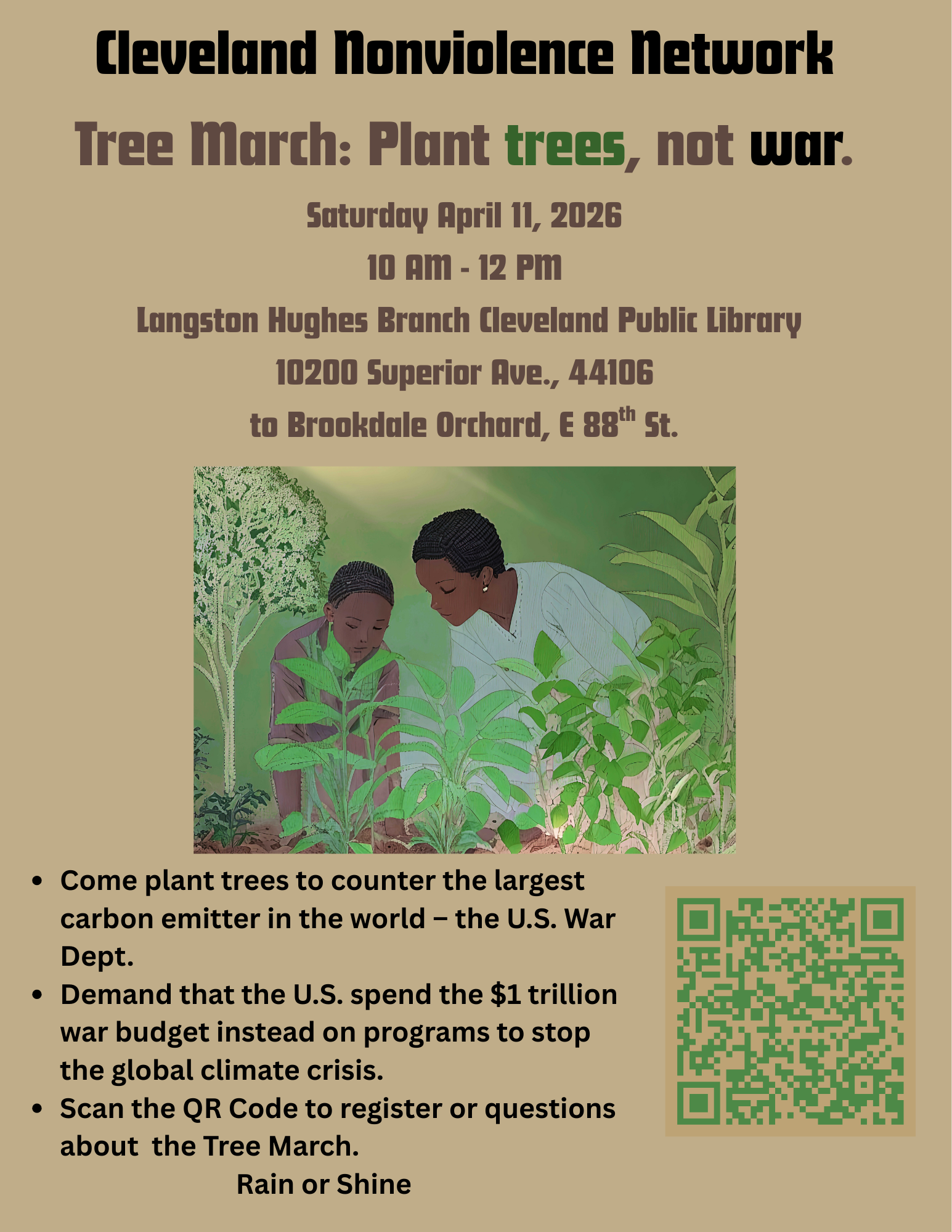
Why a tree march? Our country and planet are facing dire challenges. As we mark the anniversary of the assassination of the Rev. Martin Luther King, Jr. (April 4, 1968), we are reminded of the “triplets of evil” that he so aptly identified: racism, poverty, and war. Today, the successors of MLK’s campaigns to overcome these entrenched systems of injustice have rightfully added ecological destruction to the list. As we approach Tax Day (April 15), we admit our complicity in supporting the $1.5 trillion US war budget that fuels the US military—the largest institutional emitter of greenhouse gases on the planet. MLK warned that our nation—spending many times more on the military than on programs of social uplift—is approaching spiritual death.
Planting a tree is an act of hope. With each step forward on April 11, we’ll say YES to life and NO to death. YES to trees and NO to war. With our trees we are investing in a future liberated from the evils of racism, extreme materialism, militarism, and environmental degradation. We are taking a concrete step toward climate restoration. We are planting our vision for the future.
The Civil Disobedience + Resistance Training will provide historical grounding, practical skills and nonviolent discipline strategies anyone who wants help navigating the current landscape. Participants will leave the training with a deeper understanding of direct action, policy change and solidarity building strategies for sustaining long-term movements for justice.
To register for this training being organized by Cleveland Votes, click here
This Equal exchange article examines how Fair Trade profits are reinvested into bio-fertilizers to tackle disease and climate change conditions on co-op run farms in peru.
Between 2015 and 2025, Honduras recorded 113 murders of environmental defenders, and nine out of ten cases remain unpunished, according to data from the Association for a More Just Society (ASJ). The departments of Colón, Yoro, and Atlántida account for the majority of these crimes, in territories marked by conflicts over land and natural resources. Meanwhile, environmental organizations and defenders denounce the lack of progress in investigations and the absence of state protection for those who defend the environment.
The Inter-American Court of Human Rights has now ruled in favor of four communities harmed by the government of Honduras and outside investors.
The ancestral homelands of the Garífuna people are the coastal lands of northern Honduras and islands just off the coast. In 2003 they began filing legal complaints with the the Inter-American Commission on Human Rights (based in Washington, DC for their government’s violation of its cultural and territorial rights. Now more than a decade since the first court ruling in their favor, the government of Honduras has failed to implement the court orders. A big stumbling block is that the communities that won their cases in the Inter-American Court (2015: Triunfo de la Cruz and Punta Piedra; 2023: San Juan) are fighting private corporations and foreign investors who have a lot at stake. Some have already illegally usurped lands and built tourist resorts, so it’s tricky to figure out how to return ancestral lands to the Garífuna people and compensate the companies and investors for their losses.
As Garífuna leaders have become more vocal after the 2015 ruling, the persecution against them has increased—surveillance, intimidation, violence, criminalization. Repression is expected to increase following the fourth favorable ruling by the Inter-American Court of Human Rights. On March 4, 2026, the international body “declared the State of Honduras responsible for the violation of the rights to collective property, participation, access to information, cultural identity, food and personal integrity of the Garífuna Community of Cayos Cochinos and its members.”
Cayos Cochinos or Cochinos Cays consist of two small islands and 13 smaller coral cays situated 19 miles northeast of La Ceiba on the Atlantic coast of Honduras. The archipelago of cays is an ancestral home for the Garífuna people, whose subsistence, cultural identity and spiritual relationship are closely linked to the sea and artisanal fishing. Once the state declared the cays a protected environmental area, it authorized tourism and reality TV filming but restricted the Garífuna’s fishing rights. All of this done, of course, without prior, free and informed consultation of the community—in violation of international law.